


"Mount Mauler" sounds like a single bug, but in real life it's a Bay of Plenty beach pattern people recognise: you sit down, feel almost nothing at the time, and later (often the next day) you're left with small, intensely itchy bite spots.
A useful local reference comes from Bay of Plenty NZ, which describes "Mount Mauler" as the local name for tiny midges found on beaches near Mount Maunganui at certain times of the year. While the nickname comes from the Mount, Bay of Plenty NZ notes these tiny midges can also be found on other New Zealand coastlines. They usually live above the high-tide mark, can leave itchy red spots that last several days, and the suggested prevention is refreshingly practical: relax on damp sand rather than dry sand, and spray yourself and your towels with insect repellent.
Myth vs. Fact: Mount Mauler Edition
Myth: "Mount Mauler is just sandflies."
Fact: Locally, "Mount Mauler" is commonly used for tiny midges near Mount Maunganui beaches, often associated with areas above the high-tide mark. (Bay of Plenty NZ)
Myth: "If you didn't feel a bite, nothing bit you."
Fact: People may not notice tiny biting insects at the time. RNZ notes you might not even be able to feel Mount Maulers when they bite.
Myth: "Mount Maulers only exist at the Mount."
Fact: Bay of Plenty NZ notes these tiny midges can also be found on other New Zealand coastlines.
Myth: "Sandfly means the same thing everywhere."
Fact: In New Zealand, what we call "sandflies" belong to the blackfly family (Simuliidae). (Te Ara)
Myth: "Mount Mauler is jellyfish larvae / 'sea lice' (jelly larvae)."
Fact: Jellyfish larvae can cause “sea bather’s eruption” — an itchy rash from stings in the water that often get trapped under swimwear (especially in wetsuit cuffs / bathing suits). That’s a different scenario from the classic “Mount Mauler” beach pattern linked to tiny midges around dunes/above the high-tide line. ( Health New Zealand Bay of Plenty NZ RNZ)
This article is a field guide built from two things: reliable local information, and what I observed when I finally caught the tiny biters on camera at Papamoa Beach — plus a clear comparison to a different bite pattern I experienced at Lake Taupō.

What I observed at Papamoa Beach (the classic "Mount Mauler" situation)
I was sitting still near the dunes at Papamoa Beach. After about 10 minutes, the insects appeared suddenly in a swarm and started circling close to my feet. They were tiny and delicate — hard to photograph cleanly on a phone because macro shots get pixelated as soon as you zoom.


The bite itself was almost unnoticeable: at most a minimal "pinch" that you'd easily miss if you weren't paying attention. Initially, I only saw a tiny redness with no obvious blood crust.

Then, around 24 hours later, the reaction escalated: intense itch, firm bumps, and in places a blister-like look. Several bites sat close together in clusters.

This delayed timing is one reason "Mount Mauler" bites can be so confusing. RNZ has described Mount Maulers as something you might not even be able to feel at the time.
What it's most consistent with
Based on the size, dune-edge setting, swarm behaviour, delayed flare and clustering, the Papamoa bites behave most consistently with tiny biting midges ("no-see-ums"), rather than NZ "sandflies" (which in NZ usually refers to blackflies). This remains a "most consistent with" assessment — a confident pattern match, but not a proven species ID from phone footage alone.
One reason tiny midges can be easy to miss in the moment is simply how small the bite mechanism is. A public health entomology resource (Purdue Extension) describes biting midges as having mouthparts with minute cutting blades that lacerate the skin.
And public health guidance also notes that some people can be unaware they've been bitten because the itching may not start until hours later.
That doesn't mean the bite can't be felt. It means the combination of tiny size and delayed reaction can make the "bite moment" easy to miss — until the itch arrives later.

Taupō comparison: a different biter pattern ("sandfly" in NZ)
To keep terminology clean: in Aotearoa New Zealand, "sandflies" are blackflies in the family Simuliidae (known elsewhere as blackflies). (teara.govt.nz)

My Taupō bites felt and looked different from Papamoa. The insect I caught on my skin looked noticeably larger than the Papamoa biter, it was easily shooed away by the camera, and I clearly felt the bite happening. The itch started around day 1–2, and the reaction looked larger, with more swelling and sometimes a fluid-filled blister-like look.
Health New Zealand provides the right risk frame for NZ sandflies/blackflies: they're a nuisance rather than a public health risk, and the kinds that bite do not carry infectious diseases.
This comparison matters because everyday language mixes these scenarios — but the setting, insect size/behaviour, and reaction pattern can be quite different.
Practical beach prevention (Mount/Papamoa focus)
For the classic "Mount Mauler" situation, the simplest high-impact change is where you sit. Bay of Plenty NZ's advice is clear: choose damp sand instead of dry, and use repellent on you and your towel.
A few practical add-ons that don't ruin beach day:
- If you're near dunes and the air is still, shift your spot closer to damp sand when you can.
- Cover feet and ankles when it's bad.
- If you notice bites starting to itch, treating early can be helpful.
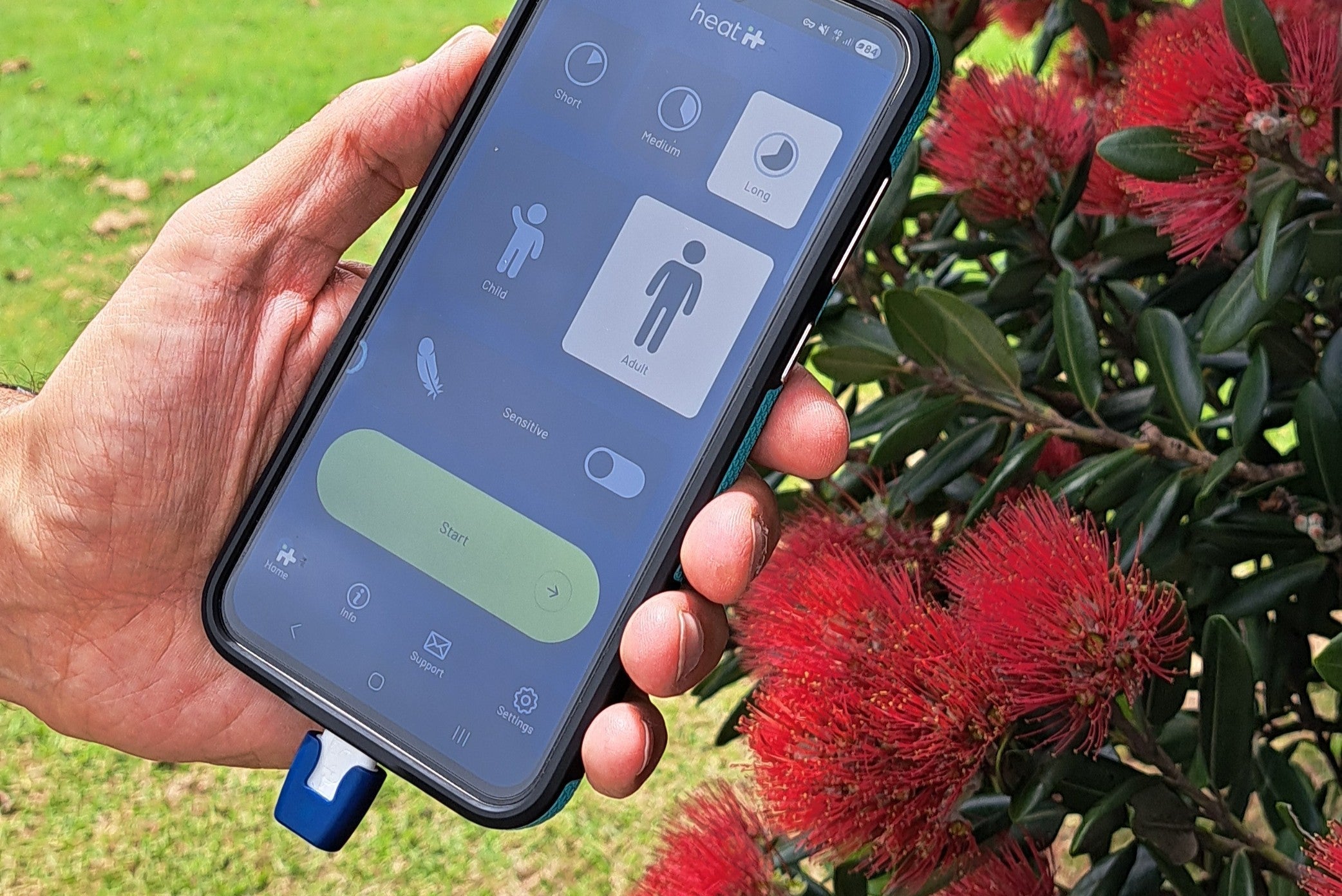
In my experience, using heat it early can calm the itch quickly in the moment — even though the area may still itch again the next day.
After-bite basics
Once the itch starts, the goal is to avoid the scratch spiral. Health New Zealand recommends avoiding scratching because broken skin increases the risk of secondary infection, and it outlines straightforward self-care options for sandfly bites.
If you're ever unsure about a severe reaction or signs of infection, seek medical advice.

Where heat it fits
heat it® is designed for short, controlled local heat application to help with itch from insect bites. It's compact, mess-free, and always with you — whether you're at the beach, on a hike, or anywhere bites happen.
Proof point: A large real-world dataset (12,000+ tracked treatments) supports concentrated local heat for reducing itch and pain after insect bites. Read the study here: Clinical Study
Quick answers
What is a "Mount Mauler"?
Locally, it's the name for tiny midges near Mount Maunganui beaches, usually above the high-tide mark, causing itchy red spots that can last several days.
Are NZ sandflies dangerous?
Health New Zealand says they're a nuisance rather than a public health risk, and the kinds that bite do not carry infectious diseases.
What's next in this series
- Taupō bites: sandflies/blackflies in NZ — what happened and practical bite care
- Tiny biting midges ("no-see-ums") — what they are, where they show up, and how not to mix them up with sandflies and mozzies

Leave a comment
This site is protected by hCaptcha and the hCaptcha Privacy Policy and Terms of Service apply.